Below is the first cut of our music video. At the moment it only features the battle scenes with the re-enactment group, Wuffa.
We are still deciding whether we should cut this footage with videos of a band playing the song, or leave the video purely as a narrative piece about children's fantasies.
As we are making a music video for our coursework our chosen ancillary products are a digipak and poster.
For our ancillary products we have decided to use a continuous theme that also has ties to our main coursework piece. For this we have decided to use a theme of Vikings throughout our ancillary product. This will involve using some pictures of the re-enactment cast taken from the filming days
Digipak -
We are going to design and create a four-panel digipak that will contain a jewel case to house a CD, as well as potentially making a small booklet to accompany the CD. This booklet would feature the lyrics to the song, as well as pictures of the cast within the music video.
In the rough design of our digipak we have thought about using a group picture of our Vikings on the front cover, facing forward and mostly all looking at the camera; as well as featuring the title of the band and the name of the song on the cover.
On the back we thought it would be best to have a picture that wasn't too busy, and so we thought about using a picture of a single Viking running through the scenery.
An idea that we had for one of the inside panels of the digipak was to use a shield as the background - making it the same size as the CD and so the shield would be hidden when the CD was in its case.
Poster -
For this ancillary product we were thinking about simply using a picture from the Viking filming day and accompanying it with the name of the band and the song title. We wanted to keep the poster simple and not too busy, but also to use interesting images to attract the attention of the audience.
As soon as we begin the designing process I will upload photos to showcase our ideas about the ancillary products better.
Posters are a good way for artists to promote their new music in busy public places or transport systems. This can be a cheap and relatively quick way of displaying the artist's work to all audiences, specifically the target audience. Music posters vary in colour and design, with some being more creative and intricate than others. Below are some posters for various musicians.
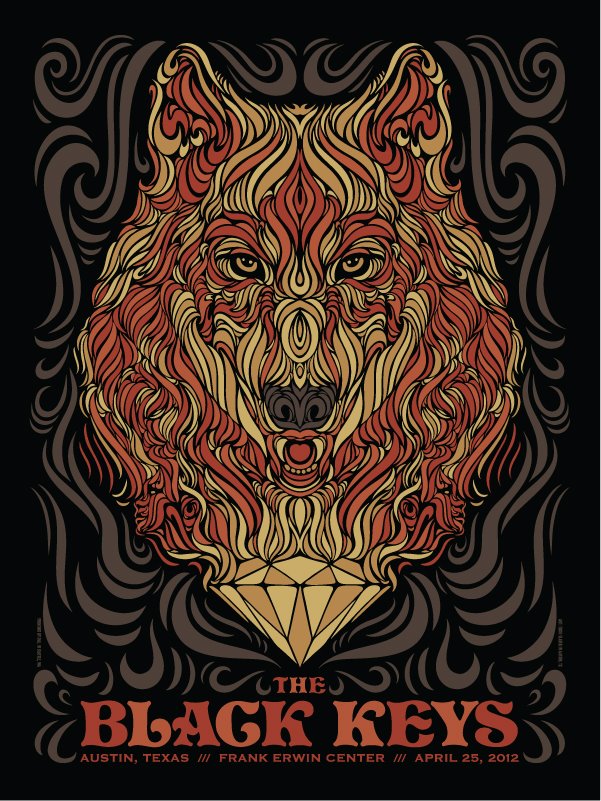
This poster is for the promotion of the American rock duo The Black Keys. I like this poster because it uses simplistic colours with the black and gold, but the main skull design is intriguing and eye-catching and so it would easily grab someone's attention when they are walking down the street or when they are using public transport. I think that the skull itself is pretty and intricate and is very appealing to look at. If I saw this on the bus or whilst walking round town, I would definitely read it and potentially want to find out more about the artist behind the poster.
The band also have some more posters that I like the look of - the two that I like the most are both creative tour posters that use animals in their designs.
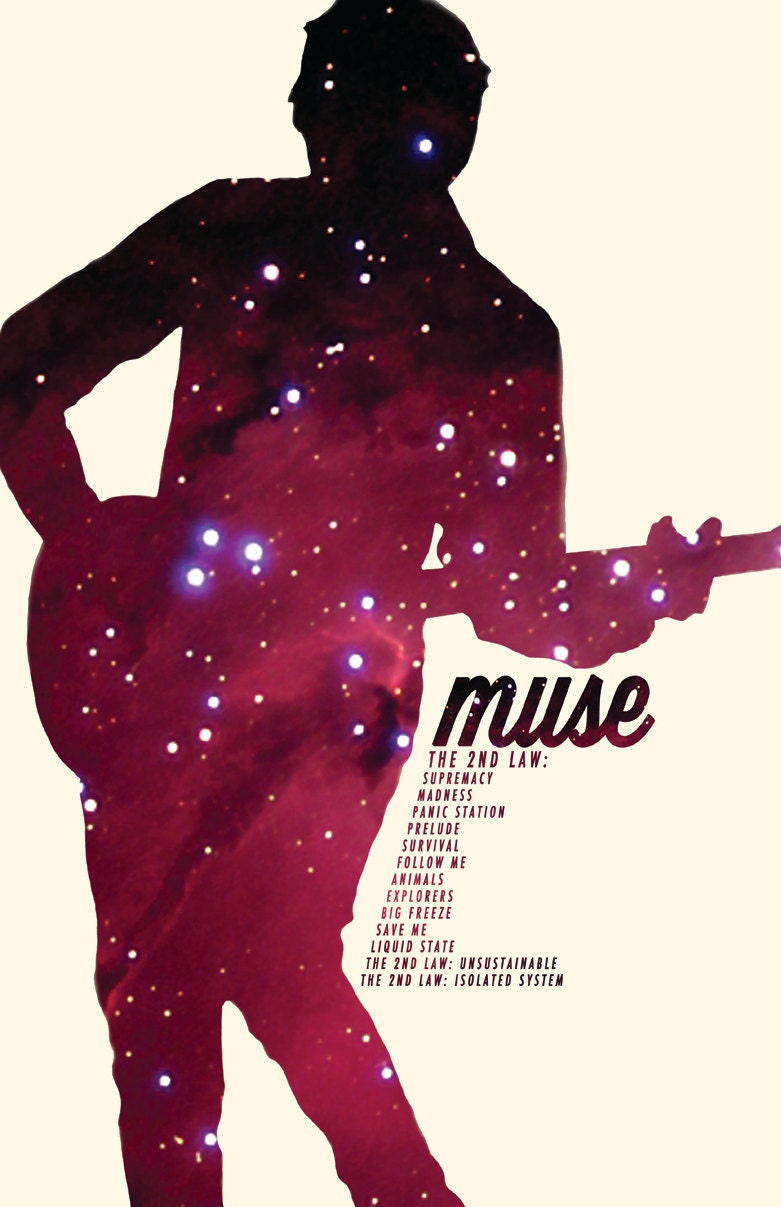
This next poster is from an English rock band called Muse, who are from Teignmouth, Devon, and were formed in 1994. This poster was used to promote their 2012 album The 2nd Law. I think that this poster is interesting to look at the silhouette of a band member is decorated with a galaxy, making it interesting and unique. The fact that the poster also contains the tracklist of the album that is being promoted is good because it may mean that someone who sees the poster will notice the name of a song that they like and then they may be intrigued to listen to the rest of the album - so gaining the band more fans. Another thing that I like about the design of this poster is that it uses different shades of a single colour, pink - I think that this gives the poster a sophisticated look, rather than using as many bright colours as possible. The different shades of pink are also not too bright and so nice to look at and, in some ways, quite calming.
This poster was used to promote the new release of the 2013 self-titled album by the American rock band Paramore. The main focus of this poster is obviously the band members themselves, and so they occupy most of it and grab the viewers attention. The fact that the image of band members is laid over a black background makes them stand out more and so more likely to be seen by passers by (even though some of the members themselves are wearing dark clothes).
I think that when we create our own poster for the promotion of our Viking music video, we will focus on using a Viking character(s) as the main focus of the poster, with other essential information on it too.
Digipaks are small cases, made from card, that are usually used when an artist releases a CD single or a special edition of an album. Digipaks are typically made with 4 or 6 panels and contain jewel cases (the plastic bits) to house CDs. Most digipaks will house only one CD but some digipaks are made to house two CDs, with a jewel case at either end of the digipak. The role of digipaks is to allow an artist to cheaply distribute their music to their target audience, as card is a lot cheaper than the typical plastic CD case, although it is not as durable and can easily become damaged.
The above digipak is from the band Mumford and Sons and is for their album Sigh No More. This digipak has six panels for pictures and text and features one jewel case to house a CD. This digipak uses plain colours and simple, yet interesting images to deliver the product to the target audience. The CD itself is a bold and contrasting colour to the rest of the product, making it easily identifiable and stand out.
This Arctic Monkeys digipak is a four-panel pack that is designed from card to house one CD in a jewel case, as well as also containing a booklet of photos of the band. This digipak uses monochrome designs and pictures to advertise the product to the target audience. One thing that I do like about the design of this product is that picture on the CD matches the behaviours of the man on the front and back cover - I think this is a much more effective design in comparison to having the CD a plain colour.
The Fall Out Boy digipak below is entirely made from card and so does not contain a jewel case for the CD - instead it slots into a card sleeve. This is a four-panel digipak that also contains a small booklet that is housed in the other side of the case. This digipak was released as a case for the deluxe version of the band's newest album American Beauty/American Psycho. The product features bright, intriguing colours and pictures of the band - all helping to catch the eyes of the target audience, making them want to buy the product. In my opinion I like the inside of the digipak very much and think that it looks artistic and interesting - something that would attract the target audience because the designs are unique and detailed. The picture on the front cover is simple, yet still interesting. The use of the American flag face-paint is appealing and helps to communicate with the audience about the title of the album, as well as potentially hinting at the fact that the band themselves are American. I also like how on the back cover, one of the band members (Pete Wentz) is turning his head to face the camera.
When designing our own digipak, we hope to make it interesting and intriguing to appeal to the target audience. In particular an album cover that I myself have liked very much is from a band called Everything Everything. I like how the front of the case shows the faces of the band and the back cover shows the back of their heads - this is an idea that I would like to incorporate into our ancillary products, especially when designing the digipak.
Something to consider when creating our music video and two ancillary products is to have a running theme throughout the three products. In our group we decided that it would be interesting to keep the theme of Vikings throughout our ancillary products and so we have began coming up with design ideas to incorporate pictures of our Viking cast, that have been used in the production of our music video, into our digipak and poster.
We filmed the main part of our music video for 'Barbarian' on 15th of November. We met with the WUFFA re-enactment team at 12 in Yarmouth by the coast and filmed for about 2 hours.
The filming itself went really well, we had 3 cameras to get different angles and shot types throughout the shoot so that we didn't have to do too many retakes. We all took part in filming and discussed ideas that each of us made, since we had gotten the basic idea of what to do and what we wanted on film from our storyboard.
The WUFFA team themselves were very good as well, as many of them had been in bigger feature films and they had their own director who knew how the battle should be done to make it look authentic and be conducted safely. The only mishap we had was when one of the actors dislocated his knee while we were filming, and an ambulance was called for him, so he had to pull out of filming, but he was happy for us to use the footage we had.
We are considering adding a live band playing the song to the video as it means we only have to use the best footage that we got on the day of filming, but we're going to have an edit with just the WUFFA scenes done first and then decide afterwards.
Overall the day went very well, and we hope that the next shoot for the last part of the video goes just as well.
15th November - filming at Gorleston-On-Sea with re-enactment group Wuffa for the battle scenes
December - filming with the Year 7 role play group for the children scenes, as well as the headmaster shot with Justin Hawkins or our backup (not set down a date or time as of writing this post)
The target audience for our music video is any fans of the rock/heavy genre that we are looking at. As music is subjective, we believe that people who enjoy the music will enjoy the video, and the age range for the audience will depend upon which age ranges enjoy the music.
The video engages with the audience mainly by the relatable scene at the end. Everyone was an imaginative child at some point so, for older audiences, they will be able to reminisce about their childhood. As well as this, we have some POV shots during the Viking battle, which will engage the audience by pulling them into the battle.
As well as the video, we are trying to attract a target audience by the use of exciting images for our Ancillary tasks (posters, CD covers, etc.). We will be using images such as the one shown here to entice the audience into buying our products and watching our video.
Here is a list of props and costumes we will need. Wuffa have their own costumes for the battle scenes, but aside from this we will need -
Stationary (including rulers, pens, pencils)
Books to be used as shields
School uniform for the children fight scene
A logo or significant object to be used in the battle and to appear at the end of the music video with the head master.
We will borrow the stationary and books from the school, the uniform the children should have on them anyway. The logo or significant object will be obtained on filming day.
Above are the storyboards for our music video. These are photos of the original storyboards that we used in our dragons den style pitch to a panel of teachers and students.
As we are doing a music video, we have decided that there will be very little dialogue, making the lyrics the main 'script'.
The song begins with a reading by a man with a traditional Norfolk accent:
One by one the Kingdoms fall They looked upon this isle and took is all Harbingers of pain Edward the Martyr cut down by a Dane On the orders of Ivar the Boneless Barbarian!
While this narration takes place we will see setting shots of the beach, the ocean, and the sky, helping to set the scene for the music video. Each clip will last no more than 5 seconds, to keep the audience engaged. The shots will all be long shots, fitting lots of scenery into the shot. As the word "barbarian" is said, the screen will fade to black. A short moment after this the next scene will appear (without fading, for impact) and should do so in time with the music.
The rest of the lyrics will be as follows:
One by one the Kingdoms fall They looked upon this isle and took is all Harbingers of pain Edward the Martyr cut down by a Dane On the orders of Ivar the Boneless Barbarian!
Remorseless Norsemen swim ashore The Eastern coast belongs to us no more! Shirtless in the rain The Heathen army's upon us Once again! Led by the sons of Ragnar
One by one the Kingdoms fall They looked upon this isle and took is all Harbingers of pain! Edward the Martyr cut down By a Dane! On the orders of Ivar the Boneless
Reducing the feeble citadels To ashes and blood stain Enslaving the sweet women-folk Whilst every man is slain
We'll spare perhaps a child or two That our legend may grow We'll take your precious horses Leave your corpses in the snow
We'll march onward Tanasia And carve the land a scar In case you were all wondering We're the sons of Ragnar!
Barbarian! (Aaaaaahhhhhhhhh) We're the sons of Ragnar! Barbarian! (Aaaaaahhhhhhhhh) We're the sons of Ragnar!
During the song, while these lyrics are being heard, there will be a great battle scene with axes swinging, shields clashing, and shouting from the Viking warriors. The audience will see a mix of long shots, mid shots, close ups, quick cuts, and POV shots. These will be seen in a manic fashion that will emphasise the excitement and the power of the battle.
After the battle, as the song draws to a close, the scene changes (see plot) to children laughing and shouting while they pretend to battle each other. The shots at this point will be less fast paced, less frequent, and more basic mid-shots. This is because it will allow the audience to be brought back to reality, not only by the characters but by the camera work. As a teacher comes to call them in he will say "Back to lessons please!" and then turn to walk away. The shot during this short piece of dialogue will be either a close up or a mid-shot of the teacher. After this, the camera will fade to black and the video will be over.
For our music video there aren't any real characters as such, its mainly just two groups acting in different scenes.
The first half of the music video will feature the re-enactment group Wuffa performing a battle scene between two sides - this group of actors are ideal for this role because they already have the skills and costumes that we would want/need for our coursework (this means that we can save time and money on finding the correct equipment and clothing for our actors).
The second half of the music video will feature a student drama group from within the school - the good thing about using a drama group like this is that they all joined the group because they have an interest in drama and acting. This means that the students that we will work with will be optimistic and helpful in the filming process, sticking to what we want them to do.
Our plot idea is as follows: The video will start with a Viking group walking towards another group on a beach/grassland setting. They will start to run towards each other and a battle will commence. A majority of the video will then be many battle shots including point of view, mid shots, long shots, and close ups. Towards the end of the battle, one character will be killed by another, and as they hit the floor (most likely in slow motion), the scene will change to a child on the floor (in the same position as the previous character). From here, the child will get up to go and pretend battle again, and as they do so, a teacher (to be played by an adult), will call them in for lessons, and as the teacher turns around to walk in with them, they will be holding a Viking prop. This will suggest that even though the children were using their imagination, that the imagination will stay with them all their lives, and they will not forget their childhood.
We came to this idea after a brainstorming as a group. We all wrote down our ideas, which were influenced by our preliminary tasks, and came to a conclusion based upon the ideas we had. I do not like any particular parts of our final idea because I believe the whole idea is clever, original, and will be exciting enough to engage an audience from start to finish.
When researching the location for the first half of our music video, we wanted somewhere that wasn't going to be busy with other people and there was enough space to film comfortably. We did think that a forest could be a good place to film, but we would then have to find an open space inside the forest so that the fighting wouldn't look too enclosed.
And then we thought about using a sandy beach to shoot our Viking battle scene on but soon discarded that idea because we didn't want to have to worry about the tide coming in and so rearranging the crew every so often.
After a little more research we found a grassland on the out-skirts of Great Yarmouth - it is the perfect location! The grassland is bumpy with a few big hills, which we can use to our advantage when filming, and there is a lot of space for the actors to run around and act in.
We chose to film at this grassland location because the re-enactment group, WUFFA, that we're using in our music video are based in the this area and so we thought that the beach near them would be perfect. This also meant that we wouldn't necessarily have to worry about whether actors could get to the location or not as essentially we would be travelling to somewhere that they are used to and is convenient for them.
When filming we hope that the weather won't be rainy or too sunny. The ideal weather conditions would be cloudy and windy. The wind would help make the acting look more realistic as a 'flying' cape will look better than one that just hangs off the actors shoulders.
The school children playing at the end of the video
The headmaster of the school, who calls the children in for lessons
The Viking group should bring some realistic footage to our video. We plan to have an authentic looking battle, which will allow the audience to engage with them by seeing the action of their fighting. The cast for this group will be the Wuffa Re-enactment group of Gorleston.
The school children should hopefully make the video more relatable. All kids have a great imagination, so by showing this through a pretend/realistic battle, we can really show the full extent of this imagination. For this cast, we plan to use a group of children in year 7 at our sixth form's high school. This was arranged after our teacher mentioned that they enjoyed re-enacting battles, and that they enjoy studying history.
The final character, the headmaster, will hopefully bring some comedy and cleverness to the video. As he turns to reveal a hidden Viking weapon, the audience will become engaged as they realise that he could have been a Viking all along. We do not yet have anyone cast for the role of the headmaster, but will hopefully have a choice within the next few days.
A successful music is one that will capture the audience's attention and keep it. The music video also needs to be unique and different, if its something that we've seen a thousand times before then its unlikely to get many views or attention. A music video that is very different and creative is OK Go's 'The Writings on the Wall'. They use a single continuous shot and optical illusions to create their video. Something like this is what would be remembered most by viewers - not so much the tune or words of the song, but the distinctive music video that accompanies it.
Another thing that contributes to the success of the music video is the narrative or the picture behind it. By this I mean that a music video may be seen as more interesting, and therefore gain more attention, if it has an intriguing plot and characters that are relatable. An example of a music video that features a plot is Michael Jackson's 'Thriller'. As well as Michael being a huge star and having a huge budget for the video, the narrative is interesting and the characters are compelling.
Some would argue that the bigger the budget, the better the music video will be. In 1995, Michael Jackson and Janet Jackson spent $7 million on the video for 'Scream' which would have been over $10 million today. But sometimes, whether intentionally or not, a band pulls off a great music video with hardly any budget at all. An example being Fatboy Slim's 'Praise You' music video. The budget for this video was $800 and it was shot guerilla-style - meaning that it is mostly improvised, there is limited crew members and is usually shot at a location without the owners permission. This music video was shot all in one take outside a California movie theatre. The video was directed by Spike Jonze (Her, Being John Malkovich and Where The Wild Things Are) and he leads the fictional 'Torrance Community Dance Group' as they perform a shaky but captivating dance routine to a live audience of confused onlookers. At one point in the video, a movie theatre employee actually comes and shuts off the music, although it doesn't stop the performers from dancing on.
At the 1999 MTV Video Music Awards this video was nominated for Best Dance Video, whilst winning three major awards for Breakthrough Video, Best Choreography and Best Direction (awarded to the dance group).
When creating a music video, it is important to divide the footage into the different types of footage that are stereotypical to music videos. These are shown in the table below:
Type of footage
Conventions
Pros
Cons
Lip Syncing
The artists will be singing, playing instruments, etc.
This will often take place on a stage or in a single room. In some videos, this will take place in an abstract setting.
It allows the band to be seen. It promotes themselves, their equipment and their perceived live ability.
If synchronisation is not clean and performed successfully, the video will not appear as successful.
Narrative story
A story between one or a few characters. In most pop songs, a love story. In some videos, it may be a journey of a character who is mentioned in the song.
It creates a better visual for the audience which can help them to remember the song.
The band may not be as associated as if they were seen in the video.
An audience may be expecting to see the band.
Mix of both of the above
Snaps between the lip syncing and the narrative. Sometimes the artist/s may be the characters within the video, lip syncing at the same time.
It eliminates the cons of just having one of the two elements. It allows the video to be more exciting, with no time period that will allow the audience to be bored.
It may be too much for the audience, so the right balance is needed for it to be successful.
For our video, we plan to use just narrative and no lip syncing. This is because we want the piece to be able to tell the story of the song successfully, so if we dedicate more of the play time to a narrative, the story will be more intriguing.
Song choice is massively important for a music video. This is because the song of choice will represent the video and vice versa, so they need to work together for the product to be successful. I believe that the music video should represent the ideas within the song. So if lyrics are about a certain time, place, or narrative, then this should be shown within the video.
For our video, we decided upon a battle scene. From here, we ended up choosing the fast paced rock song 'Barbarian' by The Darkness. We chose this video because it has strong supporting lyrics that will work with the video, the heavy genre supports a battle scene, and because it is a song that most of us listen to all the time, so it will be fun working with it.
For most heavy songs, whether this be rock, metal, etc, the video will often be fast, exciting, and full of all the logos and artwork of the band. This is because the high energy level of the video is a perfect companion to the high energy level song.
Before the big developments in technology, people in the 1940s would use vinyl (also known as PVC) to play music on a turntable. This format of playing music is becoming increasingly popular with younger generations nowadays.
In 1964 the cassette tape was created to allow people to play music whenever they wanted. Although this isn't necessarily about viewing and sharing music video, this was a big step in the consumption of music.
In 1981 the TV station MTV was created, allowing bands to share their music across TV stations in the UK and USA. By the 1990s, MTV were playing a combination of pop-friendly hard rock acts, chart-topping metal and rock acts, like Metallica. With its rapidly increasing popularity, MTV was the perfect place for bands to promote their music, as well as bringing around the idea of the music video.
In 1982 the compact disc (CD) was created, allowing audiences to listen to music in different formats.
In 1990 MTV was the only way for people to consume music video. Most people were influenced by what music to listen to as MTV was a main place for suggestions of 'popular' music.
In 2004 iTunes was created as a music sharing platform for artists. This online service allowed users to buy music and film, as well as giving them the opportunity to view music video. Any product purchased would then be made available for consumers to put onto their portable devices, typically the iPod which was created by Apple in 2001.
In 2006 Youtube was created. It is an online program in which users are able to share music videos, and more or less any media, with each other. This is now the main way that audiences consume music video.
This is one of the very first music videos and was first shown in theatres in 1925 and is filmed completely in black and white. The video solely features the musicians playing their instruments, like someone is just recording the song being played live. As we can see, music videos have changed a lot since the 1920s.
1956 - Tony Bennett - Stranger in Paradise This music video was filmed in Hyde Park, London and was the first music video to be broadcast on TV stations across the UK and the USA - this would then lead to the creation of TV stations specifically designed to broadcast music, e.g, MTV and Top of the Pops.
1964 - The Beatles - A Hard Day's Night
This is one of the first music videos to feature a narrative, still being filmed in black and white. This song is also iconic because it features in a film, as well as a music video and is one of the main influences on the creating process of other music videos to come.
1967 - The Beatles - Penny Lane
The Beatles started changing the ideas of music video production with their next video. They started using the codes and conventions of videos that are used by big modern post-production companies nowadays. Some of these techniques included dramatic lighting, unusual camera angles and rhythmic editing.
1970 - The Jackson Five - I Want You Back
The 1970's saw the music video scene change with more emphasis being put on just the artist singing. This lead to the develop of the 'cross-cutting' technique in which the music video will cut between shots of the artist singing and a complementary narrative.
1972 - Devo - The Truth About De-Evolution
This music video started off the idea of self-produced music videos, beginning the genre of the 'experimental' music video genre.
1980 - Queen - Bohemian Rhapsody
This year started a whole new style for the music video, as well as the introduction of the TV show 'Top of the Pops' - which would promote an artist's music and create a competition between them for the best song.
1981 - The Buggles - Video Killed the Radio Star
In 1981 it was the introduction
of MTV and the first video aired was 'Video Killed the Radio Star, it was a real break-through in the evolution of music videos and as
you can see it was a very high-budget video in which we can see more development
in editing such as 'over-laying'. MTV was responsible for the success
of artists, like Madonna, as it played a central role in their marketing.
1982 - Michael Jackson - Thriller
This music video began the idea of having a storyline music video that follows a narrative, almost like a mini movie. The video contains sophisticated visuals, taking the music video production industry to a whole new level. From then on music videos were seen as big promotional techniques and were beginning to be made with very big budgets.
1985 - A'ha - Take On Me
This comic book/live-action combination is known as 'rotoscoping' and meant the music video took 16 weeks to complete. Because of this unique-styled music video this got the artist a lot of promotion for their work, showing that technology like MTV and Top of the Pops was important for advertising new music in the 20th Century.
2012 - Emeli Sandé - Next to Me
Most enthusiasts often like the aesthetic appeal of music videos. Many modern artists feel the need to create aesthetically pleasing music videos to show case their songs.
2013 - Iggy Azalea - Work
In the current music video era that we live in today the adoption of the 'sex appeal' of female artists has monopolised the music industry, as these methods tend to get more attention from viewers and so makes the artist more money.
A setting is a time and a place in a moment of film. This could be anything from a shipwreck at the bottom of the ocean, to someone's bedroom. I believe that setting is incredibly important to making a successful film because it helps to set the scene for the audience. A poor or fake setting would make a story less believable.
Stereotypical settings in the common genres:
Genre
Typical Setting
Comedy
In my opinion, comedy is the only genre in which the setting options are not limited. This is because a setting can be chosen for the characters, mise-en-scene, or to create comedy itself. From the comedies that I have seen, the most common setting is one that is familiar, whether this be a school or a small town. This will be a common setting because it allows a connection between the characters and the audience.
Horror
Haunted houses, the woods, a familiar place (used to scare the audience, cause them to feel unsafe and unsure), or a very unfamiliar place (to make the audience feel lost and scared with the characters).
Romance
In teen romances, the most commonly used setting is probably schools and small towns. This is because it is a relatable setting for the typical audience, which will be teens and young adults. For older romance stories, the setting could be anything as it may be telling the tale of new love at an old age or how young love has aged over a couple’s life together. I think a suitable setting for this could be a small town during the build-up or end of a world war. This is because the war will be a very powerful equilibrium that could be used to separate or bring together the couple, and an older audience could relate to this story and setting.
Drama
In a period drama, the setting is very easy to depict and decide upon, as it has to be sensible and suit the time period. This could be a manor, a small town, or a city. Other dramas will often use normal settings that suit the time period such as a modern day city. This, such as in with many other genres, is done to create a connection between character and audience.
Documentary
The setting for a documentary is often easy to predict if given the focus of the documentary. This is because they use real footage, so the setting will be focused around the subject. For example, in a wildlife documentary, the setting during real footage would be a habitat dependent upon the species being filmed. Or for another example, a documentary on drug users would have a setting based around their homes and the streets in which they live.
Settings within our area options:
In a kids TV show, the typical kind of setting that we would expect to see is a school. This is because it is a relatable setting to a very large majority of the target audience, which makes it more enjoyable for them to watch. While this is true for many kids TV shows, some will still try and break conventions by choosing a far more abstract setting.
In a music video, there is not very often a common setting throughout, however most music videos will use the setting of a recording studio/stage for part/all of their video. This setting, when used, is usually used for the lip synchronization parts of the video, in which we will see the band/artist performing. The rest of the setting will usually be part of a story that may follow one or more members of the band. For our music video, we plan to use just a story and no live performance. This is because the song is only 3 minutes and we would prefer to use this short time to tell the story and show some brilliant cinematography.
In a short film, there are an infinite possibility of settings, and these will depend upon the genre of the film. This makes genre a very important part of setting, because if you do not successfully match the setting to the genre, it can be difficult to know which genre you are trying to achieve. For example, in a horror short film, you would expect to see settings such as haunted houses or dark alleys, so if you were to create a horror film with a light and 'happy' setting, this would not work for the genre, and the film would appear to be mocking a traditional horror film. However, as I have said in previous posts before, conventions can be broken, and it may be that the setting of a film is changed to shock the audience.
With regards to the mise-en-scene, setting is very important as it allows the characters, props, costumes etc. to work together in an environment that helps to portray the time period in which it is based. For example, a Victorian style film with Victorian costumes, props, and character names would be unfinished without a fitting Victorian era setting.
As part of the research and planning for our coursework, we had to find out about a famous film auteur. Here is our presentation about our chosen director Edgar Wright. This presentation was made by me, Luke, Dan and Charlie.
Rough script: Edgar Wright was born on April 18th 1979 in Dorset. He is a director and writer know for Shaun Of The Dead, Hot Fuzz, Scott Pilgrim vs. The World and The Worlds End. His interesting style of fast editing,whip pans and crash zooms have made him a well respected director. He also mainly work with Simon Pegg and Nick Frost, as well as using deadpan humour in fast-paced moments. I’m going to look at his different films and show the effects and styles of Wright that I might want to use in my music video or short film.
The first film we will look at is the first is Shaun Of The Dead, which was released in 2004. A parody of zombie horror films, it put the normal Simon Pegg in an extra-ordinary scenario. The film was mainly influenced by George A. Romero, who is a director of lots of zombie films like Night Of The Living Dead and Dawn Of The Dead, which this film’s name comes from. Wright also references Romero’s films a lot. Shaun Of The Dead uses a lot of whip pans and crash zooms to move from one shot to the next, and also display time moving on quickly. With the whip pans in Shaun Of The Dead, the director of photography was David M. Dunlap, who worked on Goodfellas, was able to do the whip pans on set instead of speeding them up in the editing. This made these kind of shots more realistic and less digital. He also likes having the same shot but the time of day moving on very fast, to keep the fast pace of the film going. In Shaun of the Dead, there are lots of fast action style editing for the simple things like Shaun getting dressed. I like this type of edit and want to use it for our short film or music video, as it can move small things like this on really quickly. Edgar Wright said that the trick with Shaun Of The Dead was to pull it off that “it’s a zombie film which isn't really about the zombies. That you could go through the script and replace all the zombie elements with any other obstacle, be it traffic jam, power cut of thunder storm."
The next film we will look at is Hot Fuzz, which was released in 2007. Like Shaun of the Dead, Hot Fuzz was another parody but this time a parody of police action films. Wright is a huge fan of action films, so this film is packed with all the same effects and shots he used in Shaun. He very much liked quick crash zooms to show a set up, like when Pegg was loading up with weapons. All these shots are very short and snappy, and move the story on. A very clever thing that Wright does in Hot Fuzz is his ability to story tell in a minimal amount of time. Normally if a director is moving from one scene to another he will have a shot of buildings and cars with music in the background, but Wright does things differently, as shown by this scene [show scene of Pegg moving from police station to the small town]. Wright does something completely different to the norm, turning the normal music you would hear completely down and the sound effects up, which adds to the comical aspect of the film as well. It’s all very inventive and different. Lots of times in Hot Fuzz (and Shaun Of The Dead, but mainly Hot Fuzz), Wright will take the simplest of scenes and find new ways of doing them, as well as things popping up or leaving the frame in funny ways. Martin Scorsese always said that “Cinema is a matter of what is in the frame and what is out of the frame”, and Wright uses this quote in lots of his films. Hot Fuzz also takes the most boring bits of police work and montages it in a funny, exciting, Michael Bay style. Wright also likes close ups in his films, taking influences from Scorsese who he has quoted as being the “king of the close ups”
The last one of Edgar Wright’s films we will look at is Scott Pilgrim vs The World, which is a very different style to Hot Fuzz and Shaun Of The Dead. In this film, Wright has taken loads of references from the comic itself, as well as many other video games and comics like Mario. Healso uses many of his previous styles like smash cuts, whip pans etc, but as well as this uses a lot of comic book style special effects like POW’s on the screen when someone has been hit, or lives in the corner of the screen, since this film is based off a series of comic books. This makes the film unique and appealing to all sorts of different types of fans. One cool transition effect that Wright does in this film is have the lights completely turned off to pitch black, to then come back on to reveal a different setting. He did this by turning off the actual lights on set, to make it more authentic. This also keeps the pace of the film up and engages the audience. His use of same scene transitions of time, as well as fast paced shots in simple scenes like conversations or getting changed, adds to the excitement of the film. The editing of Scott Pilgrim especially shifts reality, and moves the element of time really quickly. This way Wright is able to have better content in the film, as well as some comical content too.
So that's almost everything we like about the Edgar Wright style, most of which we hope to incorporate into our music video or short film.